How News Apps Use Stories to Increase Session Time & Subscription Exposure
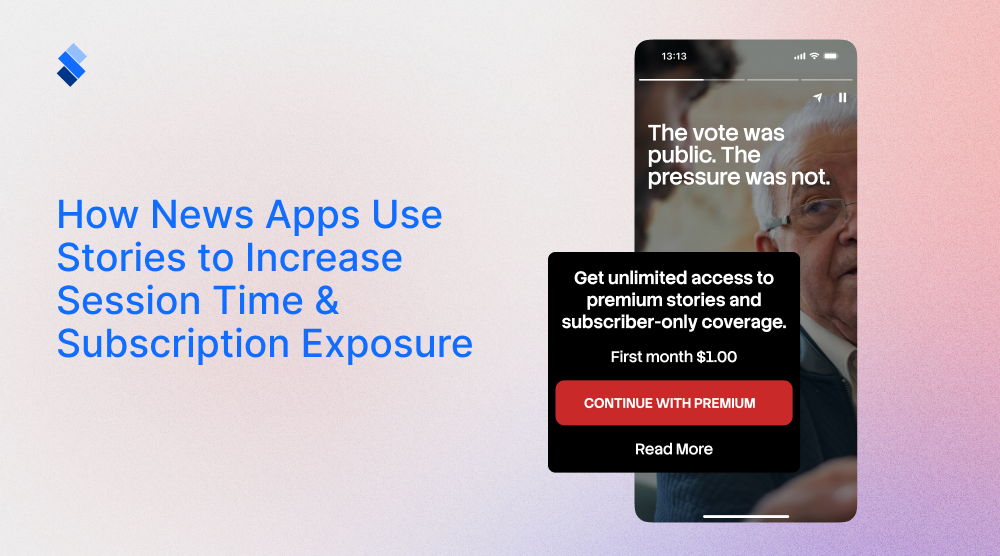
News platforms face a difficult problem. In order to engage with audiences, they need to both come up with good content and also present it in an interesting way. While this has been an ongoing problem for news publishers since time immemorial, modern times have brought specific challenges. Namely, the modern viewers are overexposed to content, overwhelmed with ads, and have very little attention to spare. As such, news publishers had to be creative in presenting their content and finding ways to monetize it. Apps present themselves as an effective solution. But creating an in-app experience that will both entertain the viewer and gently guide them towards monetization is surprisingly difficult. So, for this article, we will explore how news apps use Stories to increase session time and subscription exposure and show you how a deeper understanding of user experience can go a long way. Especially when leveraged with Story content.
What are Stories in news apps?
Before we get into specifics, let's do a quick breakdown of what Stories are and what they look like in news apps. Stories are the vertical, full-screen, tap-to-advance format. They were first popularized by Snapchat and later adopted by Instagram, Facebook, and YouTube. Over the past couple of years, they have become one of the most powerful engagement tools. For news publishers, Stories are no longer a novelty borrowed from social media. They are a native, bite-sized content aimed at increasing session time, reducing churn, and exposing more users to premium subscription offers.

In app format, Stories are primarily used to guide the user's experience. Whether it is suggesting another article, expanding on what they are already viewing, or updating them on something important. Due to their visually rich, bite-sized format, in-app Stories are terrific in conveying a lot of information in a consumable way.
Why session time matters for news publishers
It is no accident that news publishers have opted to include Story content in their online presence. After all, they are facing a structural problem. And Stories solve that problem quite elegantly.
Monetization is a big problem for news publishers. Advertising revenue has collapsed, driven by the dominance of Google and Meta in the programmatic ad market. This has led publishers to heavily depend on reader revenue brought by subscriptions, memberships, and premium tiers. But converting a casual visitor into a paying subscriber is no easy matter. Firstly, you need to establish yourself as a reputable news brand that the reader can trust. Secondly, you need to ensure that the user spends enough time in the app to discover, engage with, and ultimately value the content.
While trying to solve this, publishers noticed that the session time (the average duration a user spends inside an app during a single visit) is the biggest factor. Research regularly shows that the users who spend more time per session are significantly more likely to convert to paid plans. Not to mention that the users are more likely to share your content and to have further meaningful engagement if they spend more time. Longer sessions also mean more ad impressions for publishers still relying on hybrid monetization models.
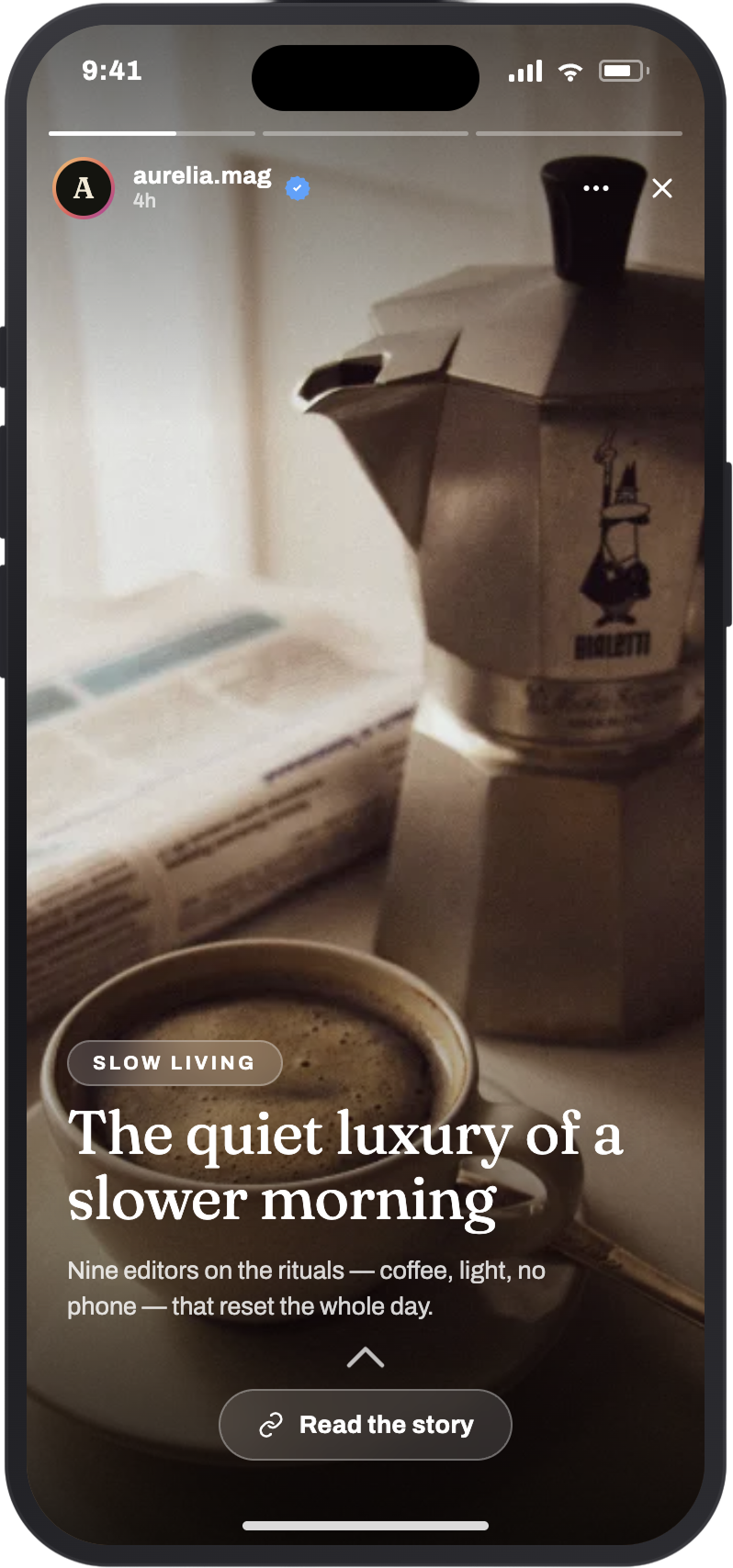
The challenge is that the traditional article feed does not naturally encourage extended sessions. A user opens the app, reads one article, and leaves. The reading experience is isolated and finite. This is the problem that Stories, so elegantly, solve.
The psychology behind the Stories format
So, Stories are a content format that enhances the standard user experience when reading an article. Why is this important? Well, to understand why Stories work so well for extending sessions, you need to understand the psychological mechanisms they exploit.
The Zeigarnik effect
The Zeigarnik effect refers to the human tendency to remember incomplete tasks better than completed ones. Stories tap directly into this. The progress bar at the top of each Story card creates a visible, incomplete task. Users feel a subtle but real compulsion to "finish" what they started. To watch the bar fill and the Story complete.
News apps stack multiple Stories in a queue, meaning the moment one completion loop closes, another opens. The user is perpetually mid-task. Another way in which news publishers leverage this is by weaving the in-app Story in a specific part of the article, promising further information about a specific subject. What's implied is that the reader won't understand the full extent of the article unless they check out the Story.
Low cognitive load
Traditional long-form articles require sustained attention and cognitive effort. Stories require almost none. Tapping through cards is nearly passive. The interaction cost is so low that users continue not because they are making an active decision to stay, but because stopping requires more effort than continuing. This utility of content with a low cognitive load is a valuable insight into readers' behaviour that publishers have learned to exploit.
Variable reward and the next-card uncertainty
Stories came from social media, where each tap delivers a small reward. This is often brought into in-app Stories. A new image, a stat, a headline, a short video. The user doesn't know exactly what the next card holds. This unpredictability activates the same dopaminergic reward pathway exploited by social media feeds and slot machines. In the context of news, it keeps users moving through content with a mild but persistent sense of anticipation.
Full-screen attention
Unlike an article feed where notifications, banners, and competing interface elements fight for attention, a full-screen Story commands 100% of the visual field. There is nothing else to look at. This immersive quality improves engagement per card and makes users more receptive to the messages.
How news apps specifically design Stories to maximize session time
Understanding the psychology is one thing. The implementation is another. So, let's outline some real-life examples where news apps truly leverage Stories.
Story sequences that mirror the news cycle
The most sophisticated news apps (BBC News, CNN, Reuters, and The Washington Post) do not treat Stories as a one-off feature. They publish Stories on a rolling basis tied to the news cycle. Breaking news, morning briefings, evening recaps, and topic-specific deep dives are all packaged as Story sequences, giving users a reason to return multiple times per day.
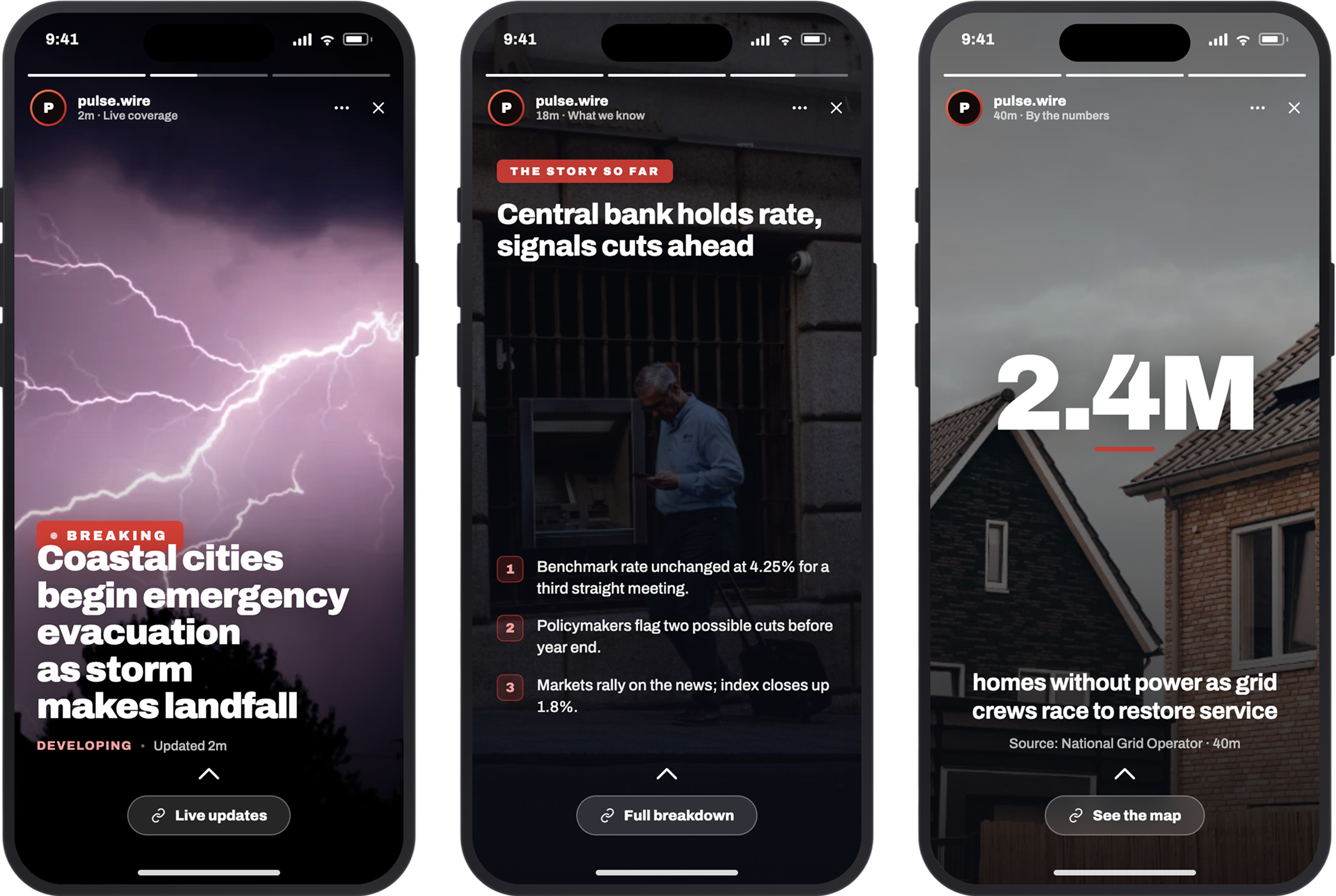
This regular Story posting is quite intentional. Users who associate a news app with a fresh Story sequence every morning develop a habitual opening behavior. The app becomes part of a daily ritual, not just an occasional pastime. Habitual users have session frequencies and durations that far exceed those of occasional visitors. As a result, their lifetime value as subscribers is substantially higher.
Cliffhanger architecture within story sequences
News editors who produce Stories for apps are increasingly making use of a technique borrowed from television: the strategic cliffhanger. A Story about an ongoing geopolitical situation might cover the background in the first five cards. Then they introduce the core conflict in the next three. And, at the moment of peak narrative tension, prompt the user to "Read the full story" with a swipe-up or tap-through to the full article.
This design serves two purposes. First, it extends session time by keeping the user inside the Story longer. Second, it drives traffic into articles, which deepens session engagement even further. The Story is not a destination. It is a funnel into a longer content journey.
Cross-topic Story chaining
There is a good reason why we can't seem to yank ourselves away from TikTok or Instagram Stories once we start viewing them. Well, Major news apps use this Story chaining to their advantage. By automatically queuing the next Story when one ends, they ensure longer session time. The Stories are usually algorithmically selected based on the user's reading history, location, and engagement patterns. A user who finishes a Story about economic policy might immediately be served a Story about a related market development, followed by one about a political figure involved in both.
This chaining behavior is engineered to feel organic and personalized (as if the app is reading the user's mind). Keep in mind that the recommendation algorithm's goal is not necessarily to serve the most important news. It is to serve the next Story the user is least likely to abandon. Session time is the optimization target.
Embedded engagement prompts
Within Stories, news apps embed interactive elements that further reduce the likelihood of a user closing the app. Polls ("Do you think the central bank should raise rates?"), swipe-up reactions, save-for-later options, and share prompts all create micro-interactions. These not only increase dwell time per card but also deepen the user's sense of participation. When users feel like active participants rather than passive consumers, they stay longer and return more frequently.
How Stories create subscribers
So, Stories prolong the session time. Longer session time means more subscribers. Is this the only way in which Stories help news apps? Of course not. The other critical function of Stories in news apps is their role in the subscription conversion funnel.
The metered paywall
There are numerous news apps that operate on a metered paywall model. Users can access a limited number of free articles or Stories per month before hitting a subscription prompt. Stories are particularly powerful in this context because they are so easy to consume in volume. A user who might read two or three articles in a session can easily tap through fifteen to twenty Story cards covering five or six different topics. Each card counts toward the metered limit.
Publishers like The New York Times have refined their Story-to-paywall pipelines carefully. The goal is to let users get deep enough into a Story to feel the value of the content before the paywall prompt appears. Stories, because of their low friction and high engagement, are exceptionally good at creating this "I want more" moment. The instant you get that, you have a strong chance of getting a subscriber.
The premium preview Story
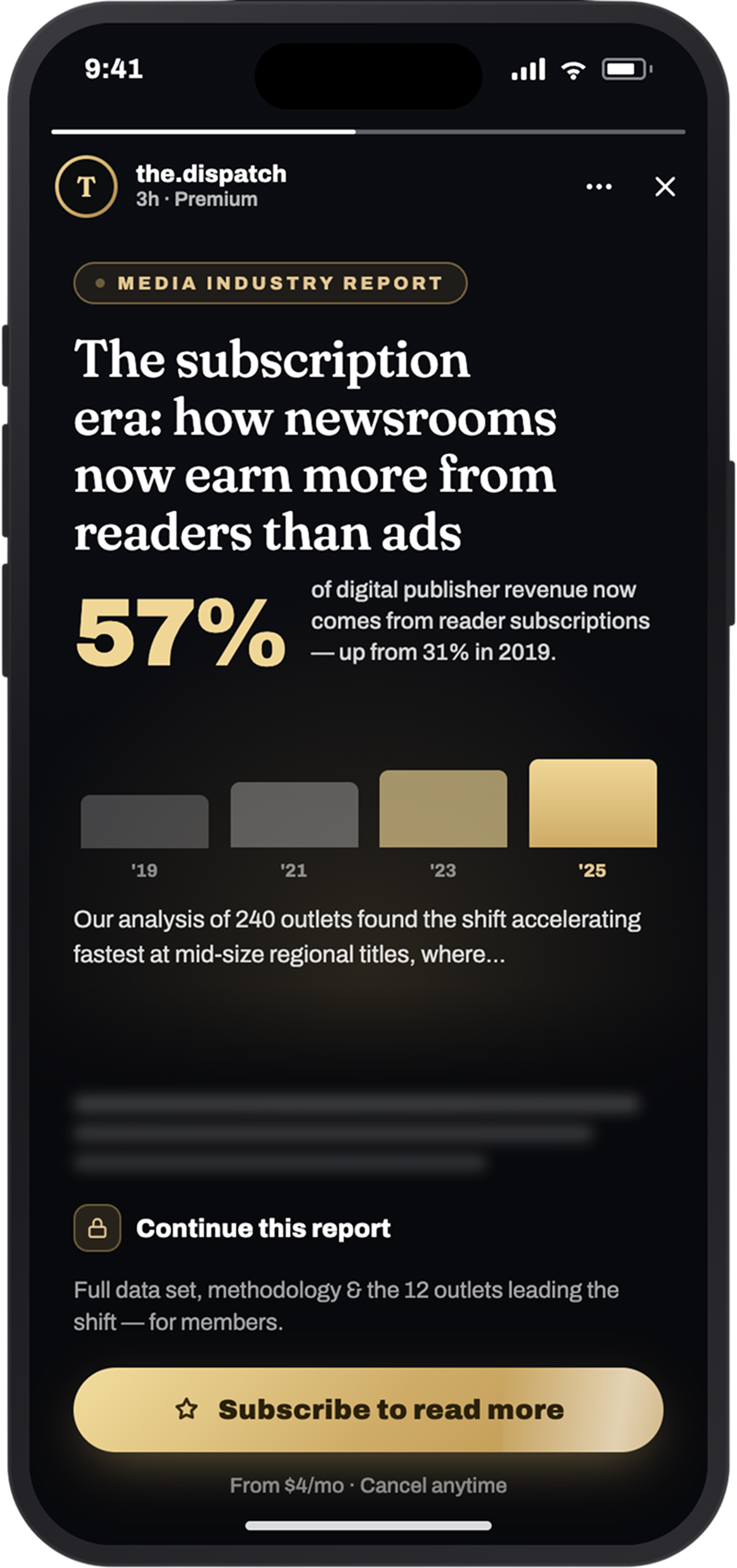
A more sophisticated technique involves publishing tiered Stories. A portion of the Story is available to all users. The final cards, typically the most contextually rich, analytically deep, or exclusively reported, are reserved for subscribers. Free users see a "Subscribe to continue" screen partway through the sequence.
This approach is psychologically powerful for two reasons. First, the user has already invested time and attention in the Story, which creates a sunk-cost dynamic. Second, the moment of interruption is at peak engagement meaning that the user is most curious and invested precisely when the paywall appears. The timing is not accidental.
The subscriber-only Story feed
Some publishers have taken a completely different approach, making the Stories feature itself a subscriber benefit. Rather than using Stories to funnel free users toward a paywall, they position access to the Stories feed as a reason to subscribe. This reframes Stories from a conversion tool into a retention and value-communication tool. Subscribers stay subscribed partly because they would lose access to a feature they use daily like live chat through Stories.
There are several regional publishers in Scandinavia that have explored this model with notable success. When a product feature becomes synonymous with the subscription, subscribers are reluctant to leave. This is because cancellation means losing something the user actively enjoys, not just access to content they can find elsewhere.
Subscription upsell cards within stories
Perhaps the most direct integration of Stories and subscription exposure is the upsell card. A full-screen card embedded within a Story sequence that promotes a subscription offer. Unlike a banner ad or a pop-up, a Story upsell card occupies the same visual real estate as the rest of the content. It does not feel like an intrusion but more like a part of the experience.
When timed correctly, these upsell cards can achieve conversion rates that significantly outperform traditional paywall placements. Ideally, they should be placed after a particularly compelling editorial card, or at the end of a sequence covering an exclusive report. The user is in a receptive, engaged state, and the offer appears in a format they are already comfortable with.
The future of Stories in news apps
Stories are not a passing trend in news publishing. They are becoming a structural feature of how mobile news is consumed. Several developments suggest their importance will only grow. The rise of AI-assisted Story production is rapidly lowering the editorial cost barrier. Tools that can automatically generate Story card sequences from existing articles will make Stories accessible to publishers who currently lack the resources to produce them manually. Even now, news publishers repurpose old, less-engaging content into well-performing stories.
Accessibility and personalisation
Another thing to note is the audio and accessibility. Integration with audio is expanding the format's reach. Stories that include ambient audio, narrated cards, or embedded podcast clips are performing well with commuter and multitasking audiences. This extends the format's utility beyond purely visual environments.
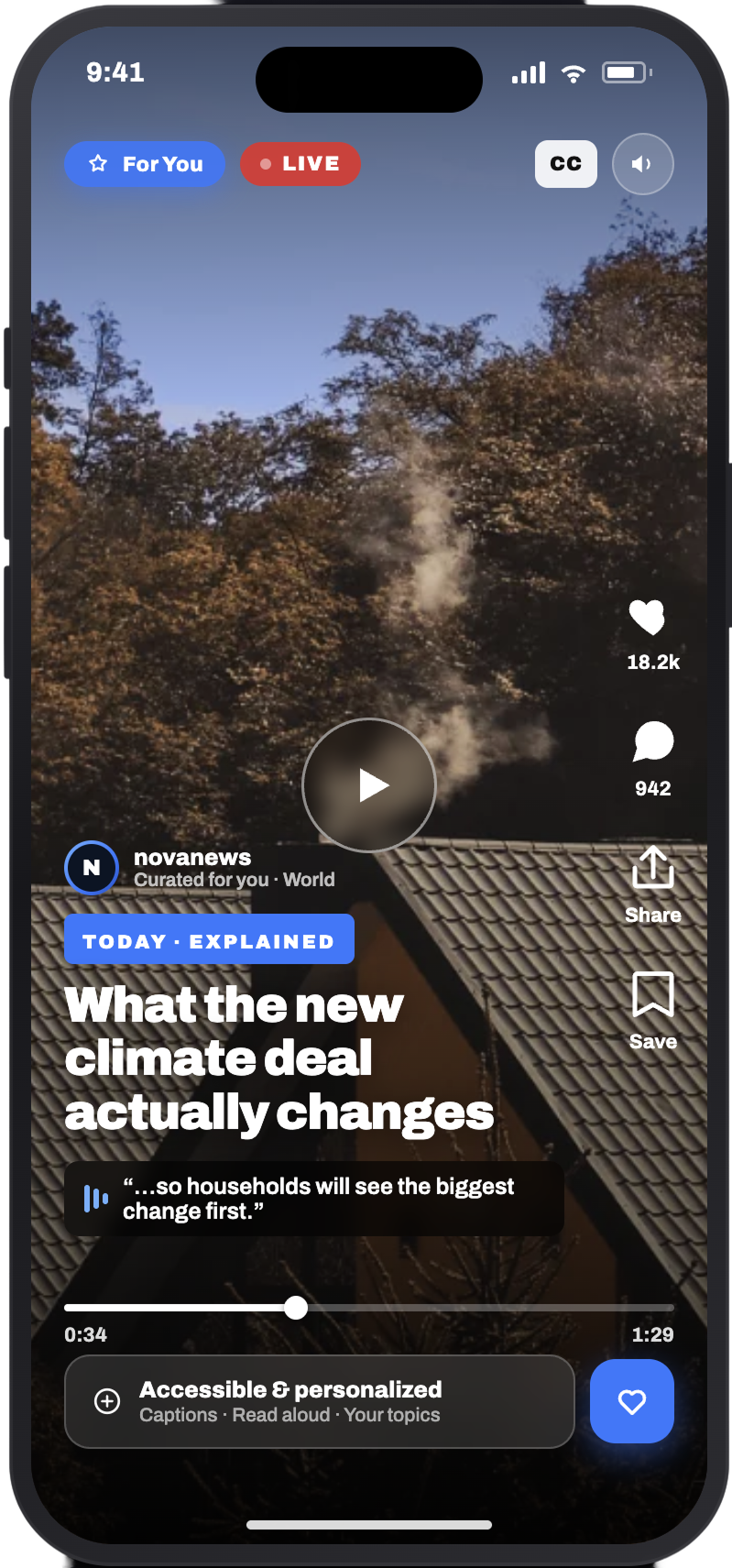
The potential in AI is in it ablity to quickly go through vast amounts of data. This enables personalisation at a scale that simply wasn't possible before. Personalization at the card level, where individual cards within a Story are tailored to a user's interests, location, or reading history, is emerging as the next frontier. Rather than serving the same Story to all users, publishers will increasingly serve dynamically assembled Story sequences that feel individually relevant.
And as the lines between social media and news apps continue to blur, the publisher who masters Stories will have a significant advantage in the battle for daily active users.
Final thoughts
Stories have evolved from a borrowed social media format into a core product strategy for news publishers. By exploiting the psychology of completion loops, low cognitive load, and variable reward, Stories drastically extend session time. And this is something that the traditional article feed cannot match. By integrating paywall mechanics, news apps transform that extended session time into measurable subscription exposure and conversion.
Mind you, the publishers winning at this strategy are not simply copying Instagram. They are designing new Stories that respect their readers' intelligence. The trick is that they've understood how readers' attention actually works and are simply meeting their readers where they are at. For any news publisher serious about growing reader revenue in 2026 and beyond, Stories are not optional. They are the new front page.
StorifyMe is an interactive engagement layer that helps news publishers deliver personalized Stories, Shorts, and interactive content experiences across their websites and mobile apps. Publishers use StorifyMe to increase session time, improve content discovery, expose more readers to subscription offers, and create new opportunities for monetization.