How Retailers Use Shoppable Stories to Shorten the Path to Purchase

All online stores face a similar problem. Shoppers discover your product, feel the urge to buy, and while navigating to a product page, they lose interest. By the time they check out, the initial impulse is gone or heavily diluted. Well, a neat way to solve this issue is to reduce the time between discovery and purchase to a minimum. And you can do this by clever use of shoppable Stories. As you'll soon learn, they collapse the distance between inspiration and transaction. And in doing so, they are quietly changing how retail works online.
What are shoppable Stories?
Shoppable stories are vertical, full-screen, swipeable content experiences with, and this is the key point, embedded purchase functionality. Think of them as interactive magazine pages that let you buy directly inside the experience. No redirects and no broken momentum. Each story consists of individual cards that users tap or swipe through. Products appear as tagged overlays. A tap on a tag reveals the product name, price, and a direct "Add to Cart" or "Buy Now" button. The purchase happens without ever leaving the story.

The idea behind this format was to extend from web stories, which combine the immersive feel of social media with the permanence of a website. Unlike Instagram Stories that vanish after 24 hours, shoppable stories live permanently on your site. They are indexable, shareable, and continuously discoverable. And they can be used to gather first-party data, which is a goldmine for retailers. This means every story is a living asset, not a fleeting post.
Retailers use Shoppable stories in several ways. A beauty brand might build a five-card "morning routine" story. Each card introduces one product with a short demo video. One tap purchases it. A fashion retailer might create a seasonal lookbook. Customers swipe through outfits and buy specific pieces without ever visiting a standard product page. A home goods brand might walk viewers through a styled room, with every item tagged and purchasable on the spot. The format is flexible, but the core idea is always the same. Keep the user inside the experience and remove every possible barrier to purchase.
Why a short path to purchase matters psychologically
Retail psychology has long understood one truth. Purchase intent is fragile. The moment a shopper feels friction, you stand to lose them. They second-guess the price. They wonder if they really need it. They close the tab.
Keep in mind, this is not laziness. It is how the human brain works. Like it or not, purchasing decisions are largely emotional and immediate. When something captures our attention and desire simultaneously, we are primed to act. But that window is narrow. Research consistently shows that longer checkout flows lead to significantly higher cart abandonment rates. The Baymard Institute has found that the average documented online cart abandonment rate sits at nearly 70%. Every extra step a shopper takes increases the chance they will walk away. Therefore, a good rule of thumb is that the fewer steps there are, the better.
Impulse buying
The concept of "impulse buying" is deeply tied to immediacy. After all, it is hard to be impulsive when you need to go through several steps to satiate that impulse. Studies suggest that up to 40% of all e-commerce purchases are unplanned. These purchases happen when the right product appears at the right moment, with no friction standing between desire and action. A standard modern sales funnel risks disrupting this. It redirects the shopper from a product discovery moment to a product listing page, to a cart, to a checkout. By step three, the emotional high has cooled, and the impulsive shopper is second-guessing themselves.

Cognitive load
Keep in mind that there is also a cognitive load factor. Every navigation step requires a mental decision. "Do I click this? Is this the right page?" Each micro-decision drains a shopper's mental energy. This is sometimes called "decision fatigue." The more decisions required before purchase, the more likely a shopper is to abandon the process entirely. Shoppable stories reduce this load to its minimum. One discovery. One tap. One purchase. Quick and easy.
Another way to minimise the cognitive load is to have your user focus solely on your content. And even here, Story content performs great. When users are inside a full-screen story, external distractions disappear. There is no sidebar, no navigation bar, no competing promotions. The brain enters a focused state. In this state, the likelihood of completing a desired action, like making a purchase, increases substantially. Removing the user from that state to complete the transaction is a strategic mistake. Keeping them inside is a competitive advantage.
Why do Stories capture attention so effectively?
In theory, every content format can be made shoppable. With some extra effort, you can make an article, an image, or even a video shoppable. So why are we focusing on Stories as the go-to solution? Well, the story format did not become dominant by accident. It earned its place by matching how modern mobile users actually consume content.
Vertical design
Phones are vertical by default. Full-screen vertical content requires no zooming, no rotating, no adjusting. It simply fills the screen and works. This alone removes a layer of friction that traditional horizontal content introduces on mobile. And with more than 60% of global web traffic now coming from mobile devices, the vertical-first format is no longer just a preference. It is a necessity.
How audiences think
Beyond screen orientation, stories match modern audiences' experience of online content. We no longer surf the web. Today's users are scrollers, not surfers. They rarely arrive at a piece of content with a clear intent. Instead, they open an app and let content come to them. In this environment, content that grabs attention in the first two seconds survives. Everything else is swiped past or heavily relies on prior interest.
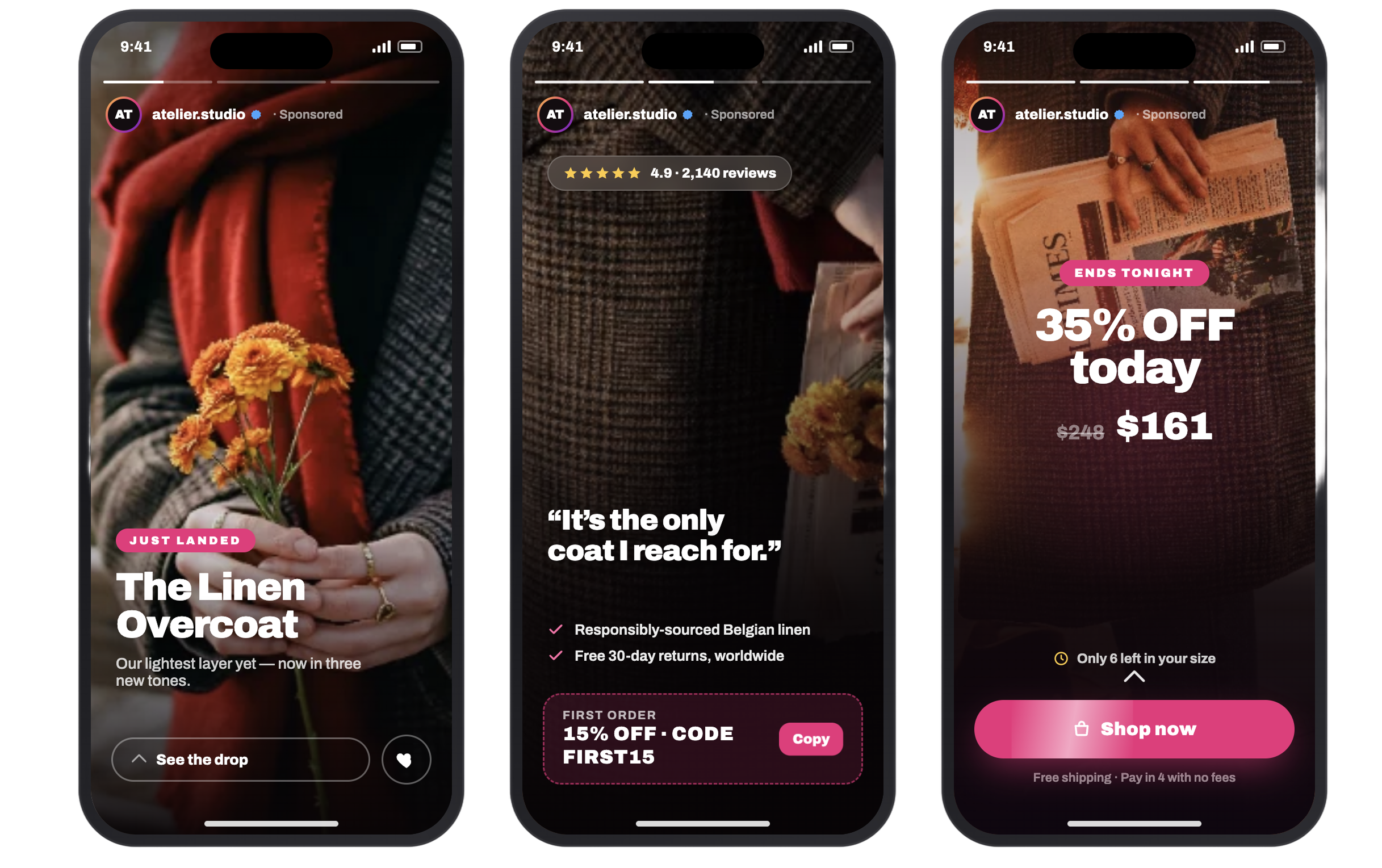
Stories are built for this. The first frame is built to earn attention immediately. Here, we usually bold imagery, strong color contrast, and minimal text signal value before a single word is read. Or a strong visual hook that manages to grab the viewer's attention. This visual-first communication is how stories overcome the passive disinterest that burdens traditional content formats. Then we have the swipe mechanic that fosters engagement. Users are not passively watching. They are actively navigating and interacting. This participation deepens attention and increases the likelihood of completing the full story. Studies on interactive content show that active participation significantly improves information retention and even emotional connection with a brand.
Remembering the incomplete
There is a psychological concept known as the "Zeigarnik effect." This is the brain's tendency to remember incomplete tasks more vividly than completed ones. It turned out that this effect is quite present within multi-paged Story content. When a Story opens with a compelling first card, the brain registers an unfinished narrative. It wants to see where it leads. This drives completion rates that traditional content formats struggle to match. Once we factor all of these in, it becomes quite clear why Story content should be your content of choice.
How supporting content must adapt
Even though they hold tremendous potential, you cannot solely rely on Shoppable. They need to be a part of a broader content strategy where different elements supplement each other. For them to perform at their best, here are a couple of things that you ought to adapt.
Product pages take a supporting role
When a story handles discovery and conversion, the product page shifts roles. It becomes a deeper reference point for research-oriented shoppers. This means product pages should prioritize detail: specifications, size guides, material breakdowns, and full review collections. Shoppers who land there are in consideration mode, not discovery mode. Give them the depth they need.
Email and push campaigns should feed directly into stories
Instead of linking to a category page or homepage, retailers should use emails to direct subscribers to specific shoppable stories. "See the new collection" becomes a story entry point, not a product grid. This maintains the narrative experience from the very first touch.

Homepage layouts should feature story rails
A horizontal row of story thumbnails near the top of a homepage acts as a mobile-native entry point for multiple product categories. Users can enter any story with one tap and be in a purchase-ready environment immediately. This replaces the traditional banner image, which demands navigation before any product interaction occurs.
Search and discovery content should point to stories
Blog posts, buying guides, and category-level SEO content are powerful sources of organic traffic. But instead of routing that traffic to a standard product listing page, consider linking to a relevant shoppable story. A blog post about "the best running shoes for beginners" becomes far more effective if its primary call-to-action drops the reader directly into a curated running shoe story with embedded purchase options.
Customer reviews, ratings, and the trust layer
Even if they consider themselves independent thinkers, shoppers rarely make purchasing decisions without seeing what other people have to say. Social media has altered our online experience so much that even when we feel sure about something, we still want some validation. Just to make sure we are making the right call. This is where customer reviews and ratings become critical, and where shoppable stories have a structural advantage.
Trust is the barrier to overcome in e-commerce. Price is rarely the primary reason for cart abandonment. Doubt is. Shoppers wonder:
- Will this product look the way it does in the image?
- Is the quality worth the price?
- Have other people had a good experience with this?
These doubts stall transactions, while social proof eliminates them. Research consistently confirms the outsized role of reviews in purchase decisions. Over 90% of customers read at least one review before making a purchase. More importantly, shoppers trust peer reviews far more than brand messaging. A five-star rating from 200 verified buyers outweighs any marketing copy a retailer can write.
The matter of social proof placement
Shoppable Stories create a natural integration point for this social proof. A story card can feature a real customer photo alongside a pull-quote from their review. Star ratings can appear directly beside the product tag. Short video testimonials can be embedded as their own story cards, turning the review into a visual narrative moment rather than a text block buried below a product description.
This placement matters enormously. In a traditional funnel, reviews live on the product page, which the shopper only reaches after leaving the discovery environment. By the time they read the review, the emotional peak of discovery has passed. Meanwhile, embedding social proof directly into the story brings validation into the moment of highest purchase intent. The question "but is it actually good?" is answered before it can form.
UGC
Having only written reviews or star ratings is the most surface-level of social proof you can weave into your product placement. But one way you can take this further is with user-generated content. When a story includes real customer photos or short video clips of the product in everyday use, it invokes authenticity. It communicates something that polished brand photography cannot: real people bought this, used it, and loved it. This authenticity is precisely what modern consumers respond to.

Lastly, Story formats also make it easy for shoppers to leave reviews post-purchase. A follow-up story triggered after delivery, asking users to submit a photo or rate the product, creates a feedback loop. New reviews feed back into future stories. The story becomes both a conversion tool and a review collection mechanism.
Final thoughts
Modern eCommerce trends are all about reducing friction. Making the buying experience as easy and stress-free as possible. With the ongoing AI advancements, it is often scary to consider what the future will be like. In a couple of years, we might see completely personalized product placements where we are offered the items we want, and the exact time we want them, and at the price tailored to what we are willing to pay. But we strongly believe that even if that day comes, Shoppable stories will be the go-to option. After all, there is no other format that both addresses the psychological background of how we interact with online content and combines multiple elements to such success.
StorifyMe is an interactive engagement layer that helps retailers turn their websites and mobile apps into personalized, shoppable content experiences. By combining Stories, Shorts, product integrations, segmentation, and first-party insights, retailers can shorten the path from discovery to purchase while increasing product engagement and conversions.