Shoppable Stories vs Product Pages: When to Use Each
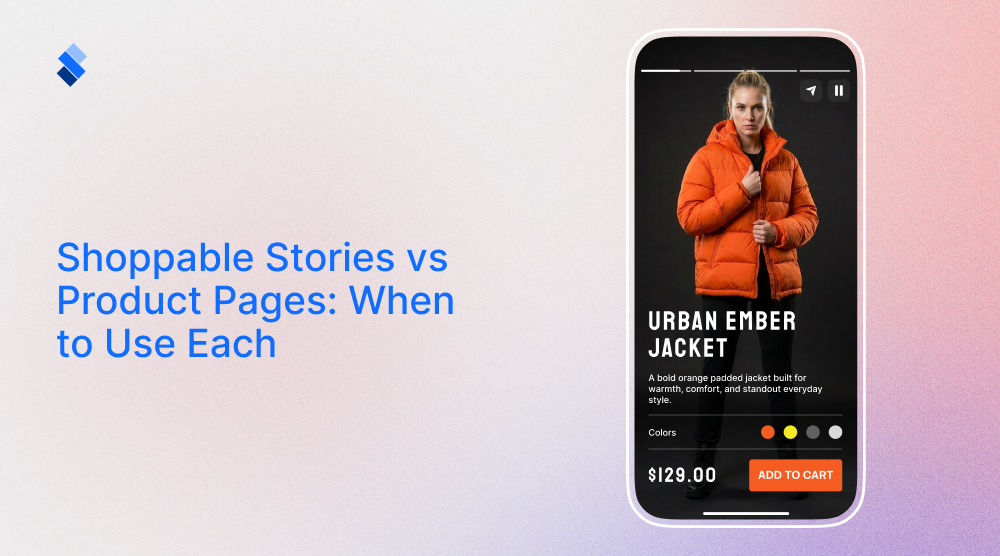
When we think of online sales, we usually think of sales funnels. The grabbing of the viewer's attention, the gradual conversion towards, and the finalized sale. And while there are various types of sales funnels, the vast majority rely on a well-designed product page. This is why e-commerce teams tend to treat product pages as the default destination for everything. A new collection drops? Send traffic to the product page. Running a seasonal campaign? Product page. Launching a collaboration? Product page. And while product pages are useful, it's quite common for them to experience low conversion rates and high bounce rates. Is this because brands forgot how to make a decent product page? Of course not. It's just that certain online trends have made them far less effective in certain roles. And crafty brands have recognized that these roles are best filled by shoppable Stories.
Understanding modern shoppers
The uncomfortable truth is that the product page was designed for a different era of online shopping. The era of PC surfers, where users came in with high intent, typed a URL directly, and were already halfway sold. Today's mobile scroller is a completely different animal. They're browsing between meetings, swiping through content while half-watching TV, and making impulse decisions in five seconds or less. As an eCommerce brand, you cannot expect the same level of interest that your predecessors enjoyed. Instead, you need to learn how to adapt and meet modern shoppers where they are.

This is exactly why shoppable Stories have entered the conversation. Their purpose is not to replace product pages, but to do the job that product pages were never built for. Understanding which format serves which moment can be the difference between content that converts and content that simply gets scrolled past. Especially if you are trying to market your content to a younger audience or motivate an impulse buy.
What is a shoppable Story?
A shoppable Story is a vertical, full-screen, swipeable content experience with embedded eCommerce elements. These can be product tags, CTAs, pricing overlays, and direct purchase links. The key thing is that they are woven directly into the narrative so that the shopping doesn't stop or in any way hinder the Story content. This is fundamentally different from linking to a product page at the end of a piece of content.
What is a shoppable Story used for?
The idea behind shoppable Stories is to convert users during moments of high emotional engagement. When the user is inspired, entertained, or curious, you push a related shopping option. They work best for product discovery, flash promotions, seasonal campaigns, influencer content... Essentially, any situation where the product experience benefits from being shown in context.
What is a product page?
A product page is a structured, information-dense web page that shows everything a user might need to make a considered purchase decision. Product images, descriptions, specifications, size guides, reviews, related products, shipping information... It's all there.
What does a product page do well?
At first glance, it might seem that product pages are relics of a past era, that all shopping should be done through stories. This is not the case. Even in the era of mobile-friendly content and social media dominance, product pages still have an important role to play. Especially if they are well-made. Product pages build trust through completeness. They give users room to compare options, read reviews, check measurements, and evaluate value. For complex or higher-cost purchases like furniture, electronics, and expensive footwear, the product page is often where the final decision gets made.

The core difference: inspiration vs. evaluation
The easiest way to understand when to use each format is to think about where the user is in their journey. Shoppable Stories live at the top of the sales funnel and also warp it so that it is quite short. They are designed for people who weren't necessarily looking to buy anything, but who are open to being offered a decent deal. Stories generate desire. They show a product in motion, in a real environment, in a context that the user can imagine themselves in. The purchase doesn't require much thought because the emotional response does most of the work.
In contrast, product pages live further down the sales funnel. They meet users in evaluation mode. This means that the users have already decided they want something similar and now need reasons to commit to this specific product. Product pages convert careful consideration into purchase through information, social proof, and structured detail.
When shoppable Stories outperform product pages
There are specific situations where a product page, no matter how well designed, simply cannot do what a shoppable Story can. Here's where Stories consistently win.
During mobile micro-moments
Stats from 2026 show that approximately 78% of all global ecommerce traffic comes from mobile devices, while mobile commerce (mCommerce) now makes up about 60% of all ecommerce sales worldwide. Even if they don't know the exact stats, brands have intuitively recognized that engaging the mobile audience is a must. And to do so, one needs to rely on mobile-friendly content, which product pages are not.
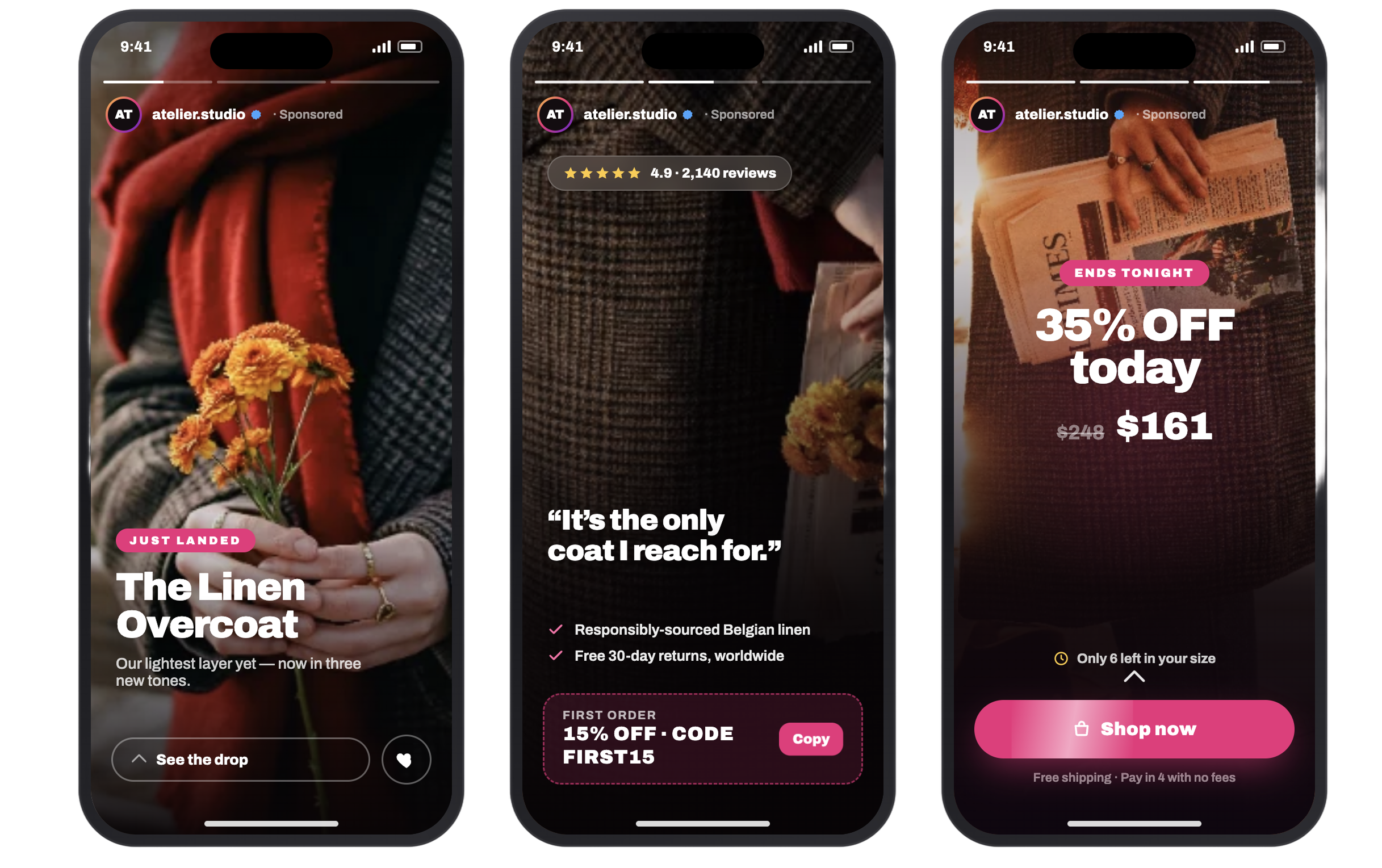
Mobile sessions are short. Users are rarely sitting down with the intention to research and buy. Instead, they're in the in-between moments of their day. A product page that requires scrolling, reading specifications, and evaluating multiple images is asking too much of someone who has maybe 40 seconds of genuine focus available. A shoppable Story, by contrast, is designed for exactly this context. Vertical format, no competing UI elements, swipe-based navigation, visual-first content. The cognitive load is minimal. The user gets what they need to make a fast, emotional decision, and the "Buy" button is right there when they feel it.
New products
When a user already knows what they're looking for, a product page gives them what they need. But if they are unfamiliar with the product, or if they even need it, they need a different approach. When the product is first presented, it requires context in a bite-sized format. Here is where a product page will struggle. Static images and a paragraph of copy can only go so far. But, a shoppable video can show a product the way a trusted friend might show you something they find interesting. This narrative context does something that product specs simply cannot. It grabs the viewer's attention and drastically increases the likelihood of an impulse purchase. Speaking of...
Impulse-driven purchases
Fashion, beauty, food, lifestyle accessories, home décor... These are some of the categories where the emotional pull matters more than the rational checklist. And these categories are all natural fits for shoppable Stories. The decision to buy a candle or a new lipstick shade doesn't usually come after careful deliberation. It comes in a moment of "I want that." Stories engineer that moment better than any other format.
Campaigns with a limited window
Flash sales, limited-edition drops, seasonal promotions, collaboration launches, or anything with urgency can benefit from Story content. Since we tend to view Story content on social media, where it disappears after 24 hours, the format naturally implies recency. So much so that it can almost feel like live content. As such, it creates FOMO in a way that a product page simply doesn't. Adding a countdown timer or a "Only 12 left" tag to a Story carries far more psychological weight than the same message buried in a product page sidebar. This is why flash sales during Black Friday or Halloween tend to benefit greatly from leveraging Story content.
When product pages outperform shoppable Stories
While it may seem that shoppable Stories are going to take over eCommerce as a whole, don't worry. Product pages aren't going anywhere, and for good reason. There are specific scenarios where the depth and structure of a product page is exactly what the user needs.
High-consideration purchases
When someone is buying a car, a laptop, or a tool that they need for their business, they're not making that decision from a swipeable Story. What they need is information. Reviews, dimensions, user guides, return policy information, comparison with alternatives... Product pages can hold all of this without forcing the user to dig. The more complex the product, the more the product page earns its keep.
Search-intent traffic
Shoppable Story is usually something you stumble upon. Meanwhile, a product page is something you actually look for. When a user types "best noise-cancelling headphones under 200 euros" into a search engine, they land on product pages (and comparison articles). Stories don't rank for transactional search queries in the same way. If SEO-driven traffic is part of your marketing strategy (and it almost certainly should be), a well-structured product page remains essential.
Product pages accumulate reviews, generate backlinks, and attract organic search traffic over months and years. They're a long-term asset. Shoppable Stories, while powerful for engagement and conversion in the short term, don't carry the same SEO weight. For sustainable organic growth, product pages remain indispensable.
Using them together
As you've likely gathered, the most effective strategy for modern eCommerce is to combine the two. Stories generate discovery and desire. Product pages confirm and complete the purchase. When both are used strategically, they create a conversion path that feels natural at every step. Each format handles the job it's best at.
Example
A fashion brand drops a new collection. They launch a shoppable Story showing the pieces styled in different settings, with product tags on each look. Users who are ready to buy immediately tap through and complete the purchase. Users who want to see more details (fabric, fit notes, size guide) tap through to the product page to evaluate before committing. Both paths lead to conversion. Neither group hits a dead end.

The Story captures the impulse. The product page catches the deliberate. Together, they convert more of the audience than either could alone.
A quick reference
Rather than treating this as a rigid rulebook, think of it as a decision framework.
Use a shoppable Story when:
- The user is in discovery mode, not yet searching for something specific
- Product benefits from being seen in context or in use
- You're running a time-sensitive campaign or promotion
- The purchase is primarily emotional or impulse-driven
- You're reaching mobile-first audiences in short attention windows
- You want to re-engage existing customers with new arrivals
Use a product page when:
- The user has high purchase intent and arrived via search
- Product has technical specifications or requires careful comparison
- The purchase involves a high cost or commitment
- You want to accumulate reviews and build organic SEO value over time
- The buyer needs to configure options, select variants, or evaluate alternatives
- You're selling to B2B audiences or in complex procurement contexts
Final thoughts
What's important to remember is that every piece of content serves a specific purpose. Some are better at engaging uninterested customers, while others are better at informing the ones that are interested. What you need to do is to research your audience and see what they best resonate with. Even if we solely focus on shoppable Stories and product pages, there are still a plethora of ways in which you can design and optimize them. And all of these design and optimization choices will be a stab in the dark if you don't know how your audience engages with online content in the first place. If you need any help with creating online content, know that StorifyMe is happy to help.