Why Web Stories Are Becoming a Core Product Feature for News & Sports Platforms
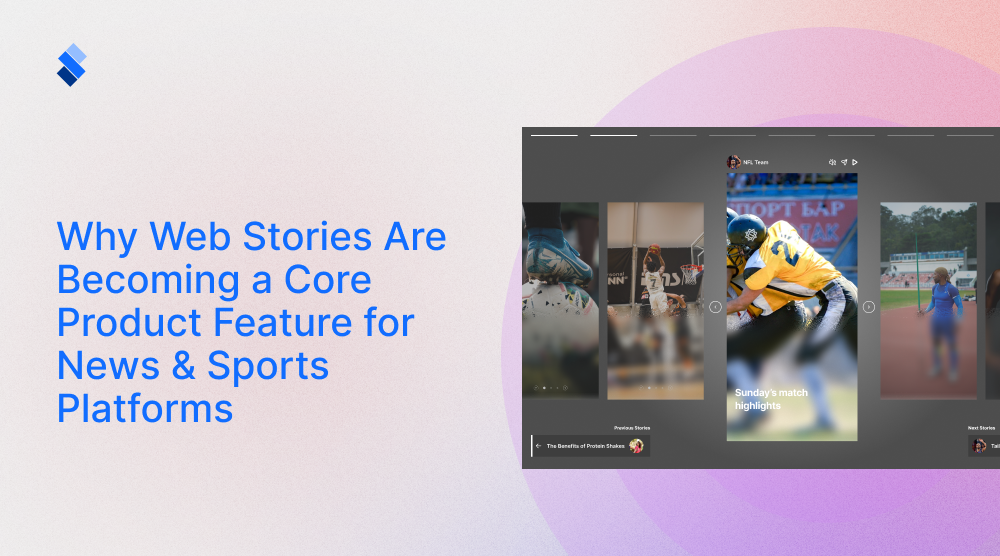
Not so long ago, web stories were seen as a fun novelty. A new, refreshing way to present visual content that is better suited for mobile phones. Before long, this novelty quickly grew to a full-fledged content format with staggering engagement rates and great viewership. Whether delivered through web browsers or mobile apps, stories represent a paradigm shift in how audiences consume information. The blend of visual storytelling, mobile-first design, and bite-sized content delivery aligned perfectly with contemporary consumption habits. All this and more made web stories a core product feature for both news and sports platforms. Let's elaborate
Why news platforms are embracing web stories
All news organizations need to navigate an increasingly competitive attention economy. When every user is able to create stories of their own and post them with surprising ease, it is no wonder that getting people's attention has become difficult. In this regard, web stories have proven to be a critical tool. The format addresses one of the most pressing challenges facing modern journalism, which is engaging an audience that is accustomed to ignoring 90% of content.
Traditional article formats, while still essential for in-depth reporting, often struggle to compete with the immediacy and visual appeal of social media. Web stories overcome this by presenting news in a format that feels native to mobile experiences while maintaining editorial integrity and brand identity. Publishers implementing web stories (both on their websites and within their mobile applications) have reported significant improvements in key metrics:
- 20-40% engagement time – Users spend significantly longer with Stories than with traditional articles.
- 70%+ completion rates – High swipe-through and story finish rates.
- 25-35% organic traffic – Boost from Google Discover, Search, and Images.
- 10-20% in-app session duration – When integrated into mobile apps.
- 20-30% higher ad CPMs – Full-screen vertical ads command premium rates.
- 90% ad viewability – Ads between cards are nearly impossible to miss.
The immersive, full-screen nature of stories eliminates distractions and creates a focused reading experience. This effectively guides users through a narrative arc, whether that's breaking news coverage, photo essays from conflict zones, or explanatory journalism on complex topics.
The technical advantages of web stories make them particularly attractive for news platforms that wish to spread their digital presence across multiple channels. A single story can be a natural bridge between a website and an app, or a social media post and a page.
Journalism and in-app stories
Within native applications, stories provide a framework for push notification strategies that feel less intrusive than traditional alerts, allowing publishers to surface timely content in a format users are already conditioned to engage with. The format's inherent shareability also amplifies reach, as users can easily distribute individual stories across messaging platforms and social networks.

Any news publisher can get great use from launching a dedicated mobile app. After all, having a direct, owned channel to their audience bypasses the volatile algorithms of social media and search engines. By prompting users to download the app, a publisher builds a valuable asset. A list of engaged users who have proactively chosen to receive their content, dramatically increasing the reliability and frequency of reach. Publishers also get first-party data on user preferences and behaviors, enabling personalized content strategies and effective push notification campaigns for breaking news or new stories, which foster loyalty and reduce churn.
But, while apps are useful on paper, they can be difficult to make useful in practice. The complexity of app design and maintenance, the UX, the flow of information, the regular updates to keep up with software advancements... All these can be a bother to deal with. Here, in-app stories came as an invaluable tool. Firstly, because they can be simply used as widgets, they are quite user-friendly when it comes to app integration. So when it comes to A/B testing, dynamic content, community-oriented features, in-app stories are your most straightforward option. Add to this that story content is the easiest bridge between online content and apps, and you get the idea of why they are core product feature.
AI (Friend or foe?)
The last thing to note about publishing is that, like it or not, artificial intelligence is revolutionizing how news platforms create, personalize, and distribute content. From one perspective, AI is essentially destroying the job of publishers, as AI platforms are becoming the go-to places to get information. On the other hand, we had the same concern for Google or Wikipedia. As of writing this article, publishers are heavily leveraging AI to create quality content in a fraction of the time it used to take them. And this extends to both web and in-app stories.

Proper use of AI transforms stories from a labor-intensive format into a scalable content product. AI-powered tools now assist journalists in rapidly transforming traditional articles into story format, automatically extracting key quotes, identifying compelling images, and suggesting optimal sequencing for maximum engagement. More sophisticated systems can analyze trending topics and breaking news to automatically generate story frameworks that editors can then refine and publish. This dramatically reduces the time from news event to story publication. Personalization engines leverage machine learning to curate story feeds tailored to individual users. By doing so, they ensure that each reader encounters a mix of topics they care about alongside important news they might otherwise miss.
Algorithms can generate automated summaries and headlines optimized for the story format. Furthermore, computer vision systems select and crop images for maximum visual impact within the vertical frame. Perhaps most significantly, AI-driven analytics provide granular insights into how users interact with each frame of a story (where they pause, what they skip, when they drop off). As you can imagine, this insight enables publishers to continuously refine their storytelling techniques and optimize UX.
How sports platforms leverage story content
Another industry where web stories have yielded tremendous success is sports. Namely, sports platforms have found web stories to be an exceptionally natural fit for their content. The format's visual-first, moment-driven structure aligns perfectly with how fans experience and discuss games. The story format excels at capturing the drama, emotion, and pivotal moments that define sports like the game-winning shot, the controversial call, the underdog victory, and the record-breaking performance.
Here, again, story content managed to fill a specific niche. Traditional sports articles had to balance comprehensive game coverage with narrative flow. That was difficult to do, at least on a scale necessary to keep viewers glued to your platform alone. Keep in mind that some want to know the score and how it compares to previous games. Others are more focused on individual athletes and whether they recovered from injuries. And some are more concerned with ongoing strategy and whether it fits the situation. All the different topics are essentially impossible to cover in a single article.

Meanwhile, web stories allow platforms to create multiple, focused narratives from a single event. One story might showcase the top plays in a stunning photo sequence. Another might provide tactical analysis with annotated diagrams. A third offers post-game reactions and locker room quotes. This modular approach to content enables sports publishers to serve different audience segments simultaneously, from casual fans seeking highlights to hardcore enthusiasts wanting deeper analysis. Both web-based stories and in-app story implementations have proven tremendously effective for sports platforms, with in-app stories particularly powerful for driving daily active usage as fans develop routines of checking their favorite team's story feed multiple times per day to stay current with the latest developments.
The real-time experience
Another aspect that articles had trouble dealing with is the real-time experience. Sure, an in-depth article describing a major event might fill the analytic needs of some audience members. But the real-time excitement of games was always lacking. And is something that sports platforms are constantly trying to include. Well, the nature of web stories makes them an ideal format for live coverage and breaking news. They allow platforms to easily update fans continuously throughout games, tournaments, and transfer windows. During live events, sports publishers can push new story frames in real-time, creating a living, evolving narrative that keeps fans engaged even when they can't watch the action directly. A basketball playoff game might generate dozens of story updates capturing each quarter's highlights, key statistics, momentum shifts, and crowd reactions, effectively providing a visual play-by-play experience accessible with just a few taps. This immediacy extends beyond game coverage to encompass the entire sports news cycle: injury reports, lineup announcements, trade rumors, contract signings, and coach interviews all lend themselves to rapid-fire story treatment.
The ephemeral quality that some platforms have incorporated into their story content (where content disappears after 24 or 48 hours) creates a sense of urgency that further drives engagement. The format's native compatibility with video makes it particularly powerful for sports content, allowing seamless integration of game clips, player interviews, and analysis segments within the swipeable framework that users find intuitive.
Sports community
From a certain perspective, sports are all about community. Sure, you might enjoy watching a game on your own. But every companion that you have in your viewership drastically enhances your experience. Even more if they are rooting for the same team and are as excited about the game as you are. Well, this enjoyment of community during sports events is something you can heavily leverage with both in-app and web stories.

A single story discussing an ongoing event in a game can become a hub for fan conversation and discussion. For instance, "Was this a foul or not?" or "What strategy would be best in the second half of the game?" A well-placed story can spark a lively conversation. And if you add a live chat in your story, that conversation can happen within your platform. This is just one of many examples of how sports platforms leverage community content to enhance their outreach and engagement. And it is just one of many examples of how story content tremendously benefits brands that know how to use it.
Final thoughts
In the age when attention is scarce and quality content is abundant, web and in-app stories stand as an effective tool. Out of all the modern content, they stand to give the biggest bang for your buck, especially if you learn how to leverage AI when creating them. Of course, to get the desired results, you will have to commit time and energy to creating them. But with platforms like StorifyMe, this shouldn't be much of an investment. Once you figure out your brand image and brand voice, you can start integrating web and in-app stories into your online presence and ensure that your voice gets heard.